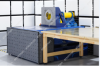
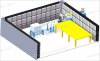
As electric vehicles advance, the adoption of 800V architectures and Silicon Carbide (SiC) power electronics is becoming increasingly common to improve efficiency, reduce weight, and enable faster charging. However, these high-voltage, high-speed systems also introduce new electromagnetic compatibility (EMC) challenges, including stronger radiated and conducted emissions. Early detection and mitigation of these issues are critical to ensure system reliability, reduce development costs, and avoid costly late-stage redesigns.
Atestman E-Drive EMC Test Benches provide a controlled, low-noise environment specifically designed to support these next-generation powertrain technologies, helping engineers evaluate and optimize EMC performance from the earliest stages of development.
As EV platforms transition to 800V systems and Silicon Carbide (SiC) power electronics, EMC challenges become increasingly complex due to faster switching speeds and higher voltage levels. These technologies can generate stronger conducted and radiated emissions, making early EMC validation essential.
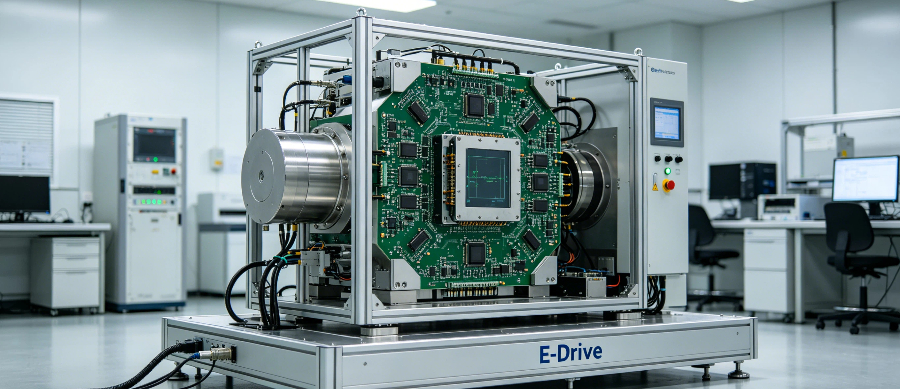
Atestman E-Drive EMC Test Benches are designed to support the testing and development of next-generation high-voltage powertrains. By providing a controlled and low-noise test environment, engineers can accurately evaluate the EMC performance of inverters, motors, and power electronics under realistic operating conditions. This enables faster identification of interference sources, optimization of shielding and grounding strategies, and improved compliance readiness before full-vehicle testing.
With early EMC verification, manufacturers can reduce development risks, improve system reliability, and accelerate the deployment of advanced 800V and SiC-based EV architectures.
The rapid adoption of 800V vehicle architectures is transforming the EV industry. Compared with traditional 400V platforms, 800V systems enable faster charging, higher power density, improved efficiency, and reduced cable weight. However, these advantages also introduce new EMC challenges, as higher voltages and faster switching events can generate more significant electromagnetic emissions throughout the powertrain.
To ensure reliable performance and regulatory compliance, manufacturers need testing solutions capable of accurately evaluating high-voltage systems under realistic operating conditions. Atestman E-Drive EMC Test Benches are specifically designed to support the development and validation of next-generation 800V powertrains, helping engineers identify and resolve EMC issues before vehicle integration.
Testing an 800V powertrain requires equipment that can safely handle elevated voltage levels while maintaining measurement accuracy. Atestman E-Drive EMC Test Benches provide a controlled environment for evaluating the EMC behavior of high-voltage components, including electric motors, traction inverters, DC/DC converters, and auxiliary power electronics.
This capability allows engineers to simulate real-world operating conditions and assess how electromagnetic emissions change across different load profiles, speeds, and power levels.
EMC performance cannot be fully understood by testing individual components alone. Interactions between the motor, inverter, cables, and power supply can create unexpected interference issues that only become visible at the system level.
Atestman test benches enable integrated testing of complete E-Drive systems, allowing engineers to evaluate conducted and radiated emissions while observing the interaction between multiple high-voltage components. This approach provides a more accurate representation of real vehicle behavior and helps uncover potential compliance risks earlier in development.
As voltage levels increase, electromagnetic noise can propagate through power cables, communication networks, grounding paths, and vehicle structures. Locating the exact source of interference can be challenging without a dedicated test environment.
Using Atestman E-Drive EMC Test Benches, engineers can isolate individual subsystems and perform targeted investigations to identify the root cause of EMC issues. This accelerates troubleshooting and reduces the time required for design iterations.
Discovering EMC problems after full-vehicle integration often leads to costly redesigns, additional testing, and project delays. Early validation at the subsystem level allows development teams to address issues before they impact the overall vehicle architecture.
By testing 800V powertrains on dedicated EMC benches, manufacturers can improve compliance readiness, reduce engineering risks, and minimize dependence on expensive full-vehicle EMC chamber sessions.
Early-stage EMC testing not only improves technical performance but also supports more efficient product development. Engineers can validate design changes quickly, compare different configurations, and optimize shielding, grounding, and cable routing strategies without waiting for complete vehicle prototypes.
This streamlined workflow helps shorten development cycles, reduce validation costs, and accelerate the launch of advanced 800V electric vehicle platforms.
The transition from traditional Silicon IGBTs to Silicon Carbide (SiC) MOSFETs is a major leap forward for EV efficiency, but it introduces severe electromagnetic compatibility (EMC) challenges. SiC technology operates at much higher switching frequencies and delivers ultra-fast voltage rise times ($dv/dt$). While this reduces energy losses, the steep voltage edges inject high-frequency common-mode currents into the system, causing massive radiated and conducted emissions that can disrupt vehicle electronics, corrupt sensor signals, and degrade motor bearings.
To counter the intense high-frequency noise generated by SiC switching, modern E-Drive EMC test benches are engineered with advanced shielding and filtering architectures. The test enclosure and the dynamometer integration use specialized, high-attenuation shielding materials to isolate the test environment.
Additionally, high-bandwidth Line Impedance Stabilization Networks (LISNs) and ultra-low-noise DC simulators are deployed to filter out transient ripples, ensuring that the bench can precisely measure the DUT's (Device Under Test) actual emissions without interference from the test equipment itself.
Fast $dv/dt$ transients will exploit any weakness in the grounding path, turning structural components into accidental antennas. E-Drive EMC benches utilize low-impedance, high-frequency grounding and bonding systems.
By implementing heavy-duty copper plane references, specialized RF grounding straps, and 360-degree shielding termination for high-voltage cables, the bench ensures that common-mode currents are safely directed back to the source. This enables engineers to accurately evaluate the effectiveness of the inverter’s internal Y-capacitors and shielding layout under realistic operating conditions.
As typical third-generation wide-bandgap semiconductor devices, silicon carbide (SiC) components have become the core choice for modern high-frequency power electronic systems. They boast outstanding advantages such as ultra-fast switching speed, low on-state loss and strong high-temperature resistance, which effectively boost the operating frequency and power density of converters, power supplies and energy storage equipment. Despite these superior performances, the extremely rapid voltage and current variations marked by high dv/dt and di/dt during SiC device switching inevitably generate strong electromagnetic interference.
The electromagnetic noise produced by fast switching will spread through conduction and radiation within the circuit.
Coupled with parasitic inductance and capacitance existing in power loops, driving circuits and device packages, it tends to cause voltage spikes and current oscillations. Such interference will distort precise sampling signals and control signals, and may even lead to false triggering of power devices, posing major threats to the normal and safe operation of the whole system. In addition, excessive electromagnetic noise will also make the equipment fail to comply with relevant electromagnetic compatibility standards, restricting the practical promotion of high-frequency SiC systems.
To address the above issues and improve system reliability, this section systematically explores effective strategies to enhance noise immunity. Multiple targeted technical solutions are presented here, including active gate drive optimization to adjust switching transients, low-parasitic circuit layout to restrain resonance noise, EMI filter circuits to suppress conducted interference, signal isolation and filtering for drive loops, as well as standardized grounding and metal shielding designs against radiated noise.
By integrating these methods comprehensively, the electromagnetic environment of high-frequency SiC systems can be greatly improved, so as to give full play to the technical strengths of SiC devices while ensuring stable and compliant operation of the equipment.
800V high-voltage platforms and SiC power devices have become key technologies for modern electric vehicles. This combination enables faster charging, lighter wiring and higher energy efficiency, and is widely adopted in new-generation EV models.
However, the high operating voltage and fast switching of SiC devices raise new risks. Severe electromagnetic interference and stricter insulation requirements pose great challenges to traditional vehicle design and certification rules.
Old test standards developed for 400V systems can no longer meet current demands. Adequate compliance preparation is therefore essential throughout the design phase.
This part elaborates on core compliance work for 800V and SiC-based EVs. It covers standard matching, EMC testing, high-voltage safety inspection and component reliability assessment.
The related design guidelines and pre-verification measures are also introduced. They help vehicles pass official certifications and maintain safe, compliant operation in real scenarios.
800V platforms and SiC power devices have become mainstream in electric vehicles, enabling faster charging, higher efficiency and greater power density. However, high operating voltage and rapid switching produce severe EMC noise, signal distortion and compliance risks.
Atestman E-Drive EMC Test Benches provide a low-noise, high-voltage test environment equipped with advanced shielding and grounding. They support early component and system-level EMC testing to pinpoint interference sources and verify noise suppression designs.
This solution resolves EMC issues at an early stage, avoiding expensive redesigns and streamlining development. It ensures EV compliance and reliability, and accelerates the rollout of next-generation 800V and SiC-based vehicle technologies.



Mr. Lind
Email:[email protected]
Hongkong office: Atestman Co. Limited
Shenzhen office: Atestman Technology Co., Ltd.
Factory site: High-tech Park, Hefei, Anhui , China