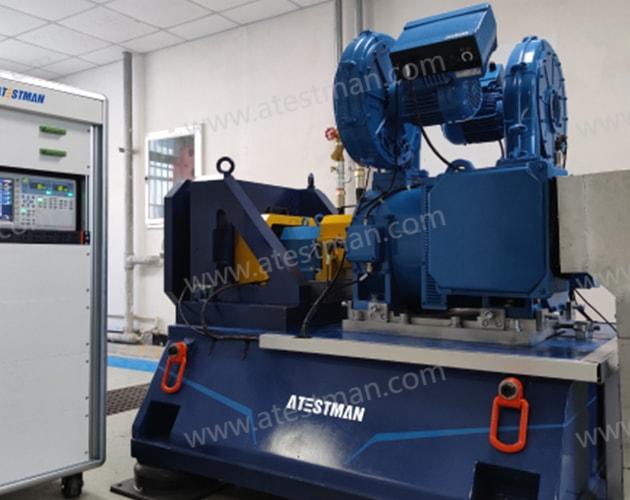
With the increasing demand for high power density motors in applications such as electric vehicles, aerospace propulsion systems, and industrial rotating machinery, high-speed motors (30,000 rpm+) are gradually transitioning from laboratory validation to real-world applications. However, vibration and temperature rise have become key issues in motor performance improvement and reliability testing. How to effectively address these challenges and ensure the accuracy of test data and long-term stability of products has become an urgent issue for engineers.
This article will explore the risks of vibration and temperature rise in high-speed motor testing, and delve into how Atestman’s "low vibration, low inertia" technology advantages help solve these problems.
Vibration is a major issue in the testing of high-speed motors. As speed increases, centrifugal force grows exponentially, significantly increasing the vibration of both the motor’s internal and external components. The main issues include:
Unbalance-Induced Vibration: Even minor imbalances or misalignments inside the motor can cause significant vibrations, which are especially amplified at high speeds. These imbalances lead to rapid increases in vibration intensity, affecting test accuracy.
Structural Resonance Problems: As speed increases, the motor’s natural frequency modes may be excited, leading to resonance and further amplifying vibration.
Instability of Test Data: Excessive vibration can destabilize sensors and testing equipment, leading to fluctuations in the test data, thereby compromising the reliability of the test results.
High-speed motors generate significant heat during operation, and temperature rise becomes a critical issue. Temperature rise is typically caused by the following factors:
Electromagnetic Losses: In high-speed motors, electromagnetic losses and eddy current effects become much more pronounced, generating excess heat. As the motor speed increases, the efficiency of converting electromagnetic energy into heat increases significantly.
Wind Losses and Frictional Heat: The high-speed rotation of components causes increased friction with air or other mediums, generating more heat.
Insufficient Cooling: Many motor designs fail to accommodate the cooling efficiency required at high speeds, causing heat to accumulate and leading to localized overheating, which impacts the motor’s stability and lifespan.
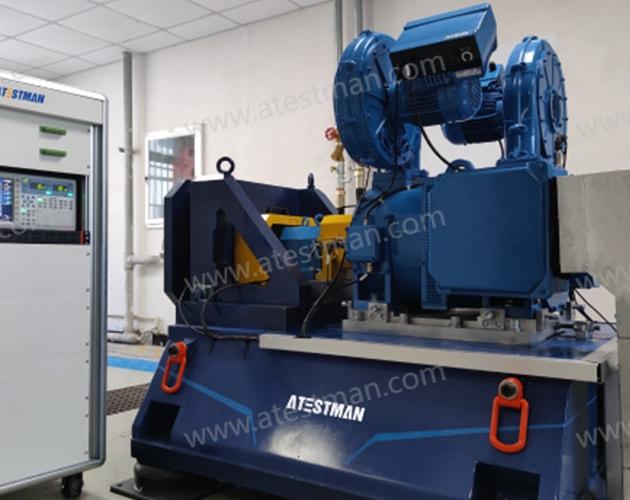
To address these challenges, Atestman offers an innovative solution, especially in terms of its low vibration, low inertia technology, which effectively reduces the risks associated with high-speed motor testing and enhances the accuracy of test data and overall stability of the motor.
Atestman’s low vibration technology reduces vibration issues at high speeds by focusing on the following aspects:
High-Precision Dynamic Balancing System: Atestman uses advanced multi-stage dynamic balancing technology to precisely calibrate both the rotor and stator of the motor, ensuring their imbalance is minimized to ultra-low levels, fundamentally reducing vibration sources.
Optimized Motor Structural Design: Using tools such as Finite Element Analysis (FEA), Atestman optimizes the motor’s structural design to prevent modal resonance, ensuring the motor can operate smoothly at high speeds without generating excessive vibrations.
Efficient Vibration Isolation Technology: Atestman employs efficient vibration isolation materials and support structures on the test platform, further minimizing vibration transmission and ensuring a stable, undisturbed test environment.
In high-speed applications, the lower the motor’s inertia, the faster its response and the more precise its control. Atestman optimizes motor performance through low inertia design:
Reduced Rotational Inertia: Atestman reduces the rotational inertia of the motor by optimizing the mass distribution of the rotor and using lightweight, high-strength materials, improving the motor’s responsiveness and dynamic control.
Reduced Impact of Inertial Forces on Structure: The low inertia design also helps minimize deformation caused by inertial forces, effectively reducing vibration and noise, thereby enhancing the motor’s stability and longevity.
Atestman’s low vibration and low inertia technology advantages effectively address the following challenges:
Reducing vibration during testing, ensuring accurate test data and stable equipment.
Improving the motor’s response speed and control precision, allowing high-speed motors to perform better.
Optimizing heat dissipation performance, reducing the additional losses caused by vibration and temperature rise, and ensuring the motor operates stably at high speeds for extended periods.
These technological advantages not only enhance the performance of Atestman motors but also provide strong support for high-speed motor testing, ensuring better reliability and accuracy in the test results.
The testing challenges of high-speed motors lie not only in increasing the rotational speed but also in ensuring the motor’s reliability and performance at high speeds. Atestman, with its low vibration, low inertia technology advantages, effectively solves the vibration and temperature rise problems, providing strong support for motor testing.
As high-speed motors become more widely used in various fields, Atestman’s innovative technology will continue to drive improvements in motor performance, helping companies gain an edge in the competitive market. By incorporating Atestman’s technology, engineers can more confidently face the challenges of ultra-high-speed motors, ensuring stable and efficient performance even at 30,000 rpm+.
This article introduces the main testing risks in high-speed motors and the key solutions Atestman provides. If you need further technical details or case studies, feel free to ask, and I can provide more specific information.



Mr. Lind
Email:[email protected]
Hongkong office: Atestman Co. Limited
Shenzhen office: Atestman Technology Co., Ltd.
Factory site: High-tech Park, Hefei, Anhui , China