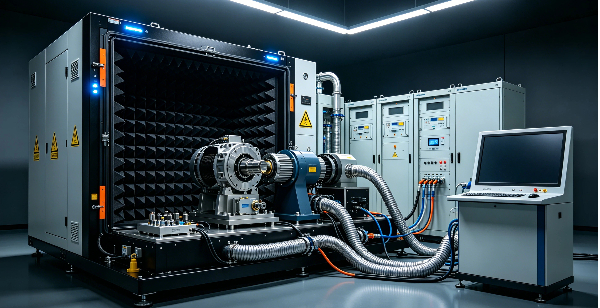
An e-drive EMC test bench is a controlled chamber-and-dyno system that measures electromagnetic emissions and immunity of EV powertrains.
アテスマン
builds test systems that align with CISPR 25, ISO 11452, and major OEM component-level EMC requirements. These systems help suppliers validate motors and inverters before mass production.
What Does an E-Drive EMC Test Bench Actually Test
An e-drive EMC test bench evaluates whether a motor, inverter, and reducer assembly generates or withstands interference under realistic loads. The bench reproduces on-road stresses in a repeatable environment. Engineers collect data on conducted emissions, radiated emissions, immunity, and functional performance.
Emissions testing focuses on unwanted electromagnetic energy leaving the e-drive. Conducted emissions travel along power and signal cables. Radiated emissions propagate from the motor and inverter housing. Immunity testing exposes the device to controlled RF fields, transients, and current injection. Functional monitoring checks torque, speed, temperature, and CAN signals.
A complete validation program includes high-voltage safety checks and thermal cycling. Typical benches support DC bus voltages from 400 V to 800 V and power levels up to 300 kW. The goal is to detect problems early and avoid costly recalls.
Why EMC Validation Is Non-Negotiable for EV Powertrains
EV powertrains switch high currents at tens of kilohertz. Electromagnetic noise can corrupt sensors, controllers, and vehicle network signals. Modern e-drives combine high-voltage batteries, fast-switching inverters, and compact windings. Each element is a potential source or victim.
Regulatory bodies and OEMs impose strict EMC limits before a vehicle can be sold. A single failure can delay certification, trigger warranty claims, or require redesign. Early validation reduces these risks and shortens the path from prototype to production.
A well-designed test bench accelerates debug cycles. Engineers isolate the inverter, motor, harness, or controller as the noise source. Functional safety under ISO 26262 demands documented EMC evidence for each powertrain component.
Core Subsystems of a Production-Grade Test Bench
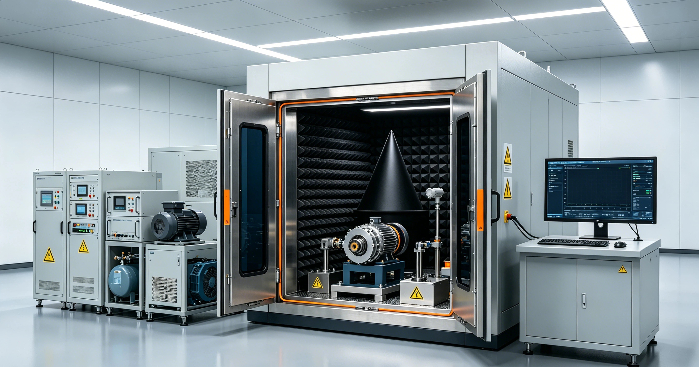
A production-grade e-drive EMC test bench is built from tightly integrated mechanical, electrical, and RF subsystems. Each subsystem must match the power level, physical size, and test frequency range.
-
RF-shielded test cell or anechoic chamber lined with ferrite tiles and absorbers. Shielding effectiveness typically exceeds 100 dB from DC to 18 GHz.
-
Dynamometer with torque sensor, speed encoder, and mechanical coupling matched to the e-drive torque envelope. The dyno supports motoring and regeneration modes.
-
High-voltage DC power supply and battery emulator able to source and sink energy during regenerative braking. Voltage ripple and transient response affect repeatability.
-
EMC measurement instruments including spectrum analyzers, EMI receivers, current probes, LISNs, and antennas. Pre-compliance instruments support debug.
-
Safety interlocks, emergency stops, and cooling loops for personnel and equipment protection. Interlock logic monitors chamber doors, temperature, and voltage.
-
Control software that sequences tests, logs data, and generates compliant reports. Software should support automated limit line comparison.
The chamber-to-dyno interface is a critical integration point. RF-shielded feedthroughs, filtered power lines, and non-metallic drive shafts must pass torque while maintaining shielding effectiveness. Poor integration here invalidates the entire test campaign.
Atestman Engineering and Customization Capabilities
Atestman designs e-drive EMC test benches combining automotive, military, and aerospace testing heritage with application-specific engineering. The company operates R&D facilities in Shenzhen and a production base in Hefei. This dual-site model supports rapid prototyping and volume production.
The team holds over 50 granted or pending patents and more than 10 certifications. Atestman provides flexible toolsets, engineering consultancy, and after-sales support. Custom solutions range from chamber upgrades to fully integrated powertrain EMC test systems.
The company served the Chinese market under JK Test for over a decade and now operates globally as Atestman. Its technologies are trusted across automotive, military, aerospace, and industrial machinery sectors.
Atestman acts as a manufacturer, supplier, and OEM/ODM partner for test bench projects. The team supports mechanical integration, electrical design, and software development. This end-to-end capability helps customers avoid fragmented vendor management.
How to Select and Commission an E-Drive EMC Test Bench
A structured selection process prevents oversizing, underspecification, and integration delays. Buyers should match the bench to the e-drive portfolio, not just the first product on the roadmap.
-
Define the test scope and required standards, including emissions, immunity, and loading profiles for each e-drive variant.
-
Size the chamber and dynamometer to match the peak power, torque, and physical envelope of the entire e-drive family.
-
Select power supply, battery emulator, and measurement instruments for the required frequency range and accuracy class.
-
Integrate RF feedthroughs, mechanical fixtures, cooling loops, and grounding to maintain shielding effectiveness and safety.
-
Calibrate the system with reference sources and run a baseline EMC test to confirm repeatability within the specified tolerance.
-
Train operators, document procedures, and establish a maintenance plan before production testing begins.
Commissioning includes factory and site acceptance testing, and on-site installation. The final handover should include calibration certificates, test templates, and training records. These steps reduce ramp-up time and ensure credible production tests.
Common EMC Test Standards for E-Drives
| スタンダード |
周波数範囲 |
一般的なアプリケーション |
|
CISPR25
|
150kHz~2.5GHz
|
Conducted and radiated emissions from vehicle components
|
|
ISO-11452 2
|
200 MHz – 18 GHz
|
Radiated immunity in anechoic chambers
|
|
ISO-11452 4
|
1 MHz〜400 MHz
|
Bulk current injection immunity testing
|
|
ISO-7637 2
|
Transient pulses
|
Transient tests on supply lines
|
|
LV 124 / VW 80000
|
DC to RF range
|
OEM-specific electrical and EMC tests
|
結論
A well-designed e-drive
EMC試験ベンチ
gives EV suppliers confidence in meeting emissions and immunity requirements before the vehicle reaches the road. The right combination of chamber, dynamometer, power supply, and instrumentation reduces certification risk and shortens development cycles.
Request a Rapid Sourcing Quote from
アテスマン
for your next project. Contact Atestman Engineering Team for Free Custom Design Support on chamber sizing, dyno capacity, or test standards.
FAQ
What is the typical frequency range for e-drive EMC emissions testing?
Most emissions testing follows CISPR 25 from 150 kHz to 2.5 GHz. The lower band covers conducted emissions on power cables, while the upper band covers radiated emissions from the motor and inverter. Some OEMs extend testing above 5 GHz for radar-band coexistence.
Can a standard dynamometer be installed inside an EMC chamber?
No, standard dynamometers contain brushed motors and drive electronics that emit electromagnetic noise during operation. A chamber-compatible dyno requires RF-shielded enclosures, filtered motor drives, and non-conductive shaft couplings. These modifications are essential to prevent the dynamometer from interfering with sensitive EMC measurements.
How long does commissioning an e-drive EMC test bench typically take?
Commissioning depends on system complexity and site readiness. A typical integrated bench requires four to twelve weeks from equipment arrival to site acceptance. Key factors include chamber assembly, dynamometer alignment, instrument calibration, and software configuration. Operator training typically adds one to two additional weeks.
Does Atestman provide on-site installation and operator training for test benches?
Yes, Atestman delivers on-site installation, commissioning, and operator training as core parts of its custom-engineered solutions. The engineering team also provides remote technical support and preventive maintenance planning after handover. These services help customers maintain test repeatability and equipment uptime over the long term.
What data should a test bench report include for regulatory and OEM
監査ですか?
A compliant report should include the test setup photo, equipment calibration records, e-drive configuration details, ambient conditions, raw measurement plots with limit lines, and clear pass/fail conclusions. Traceable data with documented measurement uncertainty supports regulatory filings and OEM engineering reviews.